The best in-ear monitors for singers start with the Shure SE215 for budget use, the Jerry Harvey Audio JH7 for mid-range stage performance, and the Shure SE846 Gen 2 if you want premium sound every night. In-ear monitors replace the floor wedge speakers that used to sit at your feet on stage.
They go directly into your ears, give you a custom mix of exactly what you need to hear, protect your hearing from stage volume, and free you to move anywhere without losing your monitor mix.
This guide covers the top passive IEM earphones for singers at every price point, plus the wireless systems that cut the cable so you can move around stage freely. We'll explain what to look for, the difference between passive earphones and full wireless systems, and how to set everything up.
Whether you're playing your first 100-seat show or touring theatres, there's a setup here for your budget.
What In-Ear Monitors Are and Why Singers Use Them
In-ear monitors (IEMs) are small earphones worn by musicians on stage. They plug into a bodypack receiver or headphone amp and deliver a personal monitor mix directly to your ears. They isolate your ears from stage noise so you can hear yourself, the band, and a click track clearly, even at a loud show.
The main reasons singers switch to IEMs:
- You hear your own voice clearly. No more straining to hear yourself over the band.
- Better pitch and intonation. When you can hear yourself, you sing better.
- Hearing protection. Floor wedges, when pushed at high volumes, damage hearing over time. IEMs keep levels controlled and safe.
- Custom personal mix. More guitar, less drums? You decide.
- Total stage freedom. Wireless IEM systems let you move anywhere without cables.
Once a singer switches to IEMs, almost none go back to wedges.
IEMs vs Floor Wedges: The Real Differences
Floor wedges are the speaker wedges that sit at your feet, pointing up at you. For decades they were the only option. Here's how they compare to IEMs:
| Category | Floor Wedges | In-Ear Monitors |
|---|---|---|
| Sound quality | Variable; affected by stage noise | Consistent; isolated from stage |
| Hearing protection | Requires loud volumes | Quieter, safer long-term |
| Feedback risk | High | Almost zero |
| Custom mix | Shared with others nearby | Fully personal |
| Stage movement | Limited by speaker position | Full freedom (wireless) |
| Cost | Higher (PA gear) | Lower upfront |
| Setup time | Longer | Shorter |
IEMs win on almost every point once you account for the learning curve. The main adjustment is psychological: some singers feel disconnected from the room when they first switch. That passes quickly.
Passive IEMs vs Wireless IEM Systems
This is the part that confuses most beginners. There are two separate things you're buying:
1. IEM Earphones (passive): These go in your ears. They're just earphones with high isolation. You can use them wired (from a headphone amp or mixer headphone out) or with a wireless system. Brands include Shure, Sennheiser, Audio-Technica, Mackie, Jerry Harvey Audio, and more.
2. Wireless IEM System: This is the transmitter and receiver that send audio from the mixer to your ears without a cable. The transmitter sits on the mixer or in the rack; the bodypack receiver clips to your belt or in your pocket. You plug your earphones into the bodypack.
You can use passive IEMs wired without a wireless system. Many singers in smaller venues just run a cable from the monitor output on the mixer straight to their bodypack or headphone amp. Wireless systems add cost and complexity but give you full stage freedom.
For home practice, you can also run IEMs straight from your audio interface headphone jack, which is a great way to get used to hearing yourself without any extra gear.
What to Look For When Buying
1. Driver count.
More drivers generally mean more detail. Single-driver IEMs are clear and budget-friendly. Dual-driver adds depth. Triple-driver and above separate the frequencies into dedicated drivers for highs, mids, and lows, which is what pro singers prefer.
2. Isolation (dB of noise reduction).
Most passive IEMs reduce outside noise by 26 to 42 dB. The higher the isolation, the quieter the stage noise that bleeds in. This matters most on louder stages.
3. Fit and ear tip options.
Fit is everything. A good IEM that fits you beats an expensive one that doesn't seal your ear. Always check what ear tip options are included: foam tips seal better but wear out, silicone tips are durable.
4. Cable quality.
Look for a detachable, over-ear cable design. Cables break; being able to replace just the cable instead of the whole unit saves money.
5. Sound signature.
Singers generally want clear mids (where the voice lives) and enough low-end to feel the kick drum and bass. Avoid V-shaped sound signatures (boosted bass and treble with recessed mids) because they make it harder to hear your own pitch.
6. Wireless vs wired.
If you move around the stage, get a wireless system. If you stand at a keyboard or mic stand, a wired connection is simpler and cheaper.
Quick Comparison Table
| IEM | Driver | Isolation | Price | Best For |
|---|---|---|---|---|
| Shure SE215 | 1 Dynamic | 37 dB | $100 | Budget starter |
| Sennheiser IE 100 Pro | 1 Dynamic | 26 dB | $109 | Budget (more comfort) |
| Jerry Harvey Audio JH7 | 3 BA | 26 dB | $599 | Best mid-high range |
| Shure SE425 | 2 BA | 37 dB | $267 | Balanced, clear mids |
| Audio-Technica ATH-E70 | 3 BA | 35 dB | $439 | Best for vocals |
| Mackie MP-460 | 4 BA | 40 dB | $529 | Pro stage all-rounder |
| Shure SE846 Gen 2 | 4 BA | 37 dB | $890 | Best overall |
BA = Balanced Armature driver
You can pick up every IEM in this list through Zzounds, with free shipping and interest-free payment plans on purchases over $99.
Top 7 IEM Earphones for Singers
1. Shure SE215 (Best Budget IEM)
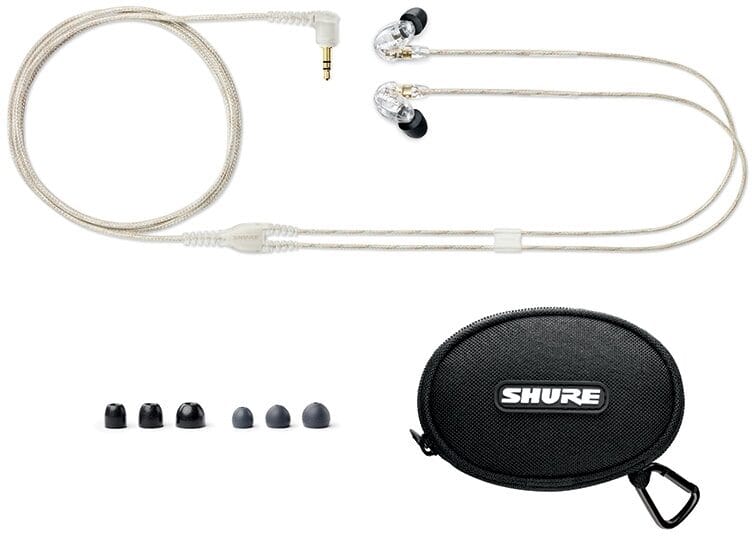
Drivers: 1 dynamic
Isolation: 37 dB
Best for: Beginner singers, first-time IEM users
The SE215 is the most popular entry-level IEM in live music. It's durable, comfortable, and blocks 37 dB of stage noise, which is genuinely impressive at this price. The sound leans warm with strong low end, which makes you feel connected to the kick drum and bass even when everything else is quiet in your mix.
What we love:
- 37 dB isolation is excellent for the price
- Durable, over-ear cable design with MMCX connector
- Comfortable enough for a full 90-minute set
- Available in a dozen colors
- Easy to replace the cable when it eventually wears out
Watch out for:
- Single dynamic driver; not the most detailed IEM
- Treble can sound slightly rolled off on some voices
- Won't match a dual or triple driver on vocal clarity
If you want to try IEMs for the first time and don't want to spend $300 on something you might not love, start here.
Check the Latest Price and Full Specs
2. Sennheiser IE 100 Pro (Best Budget Alternative)
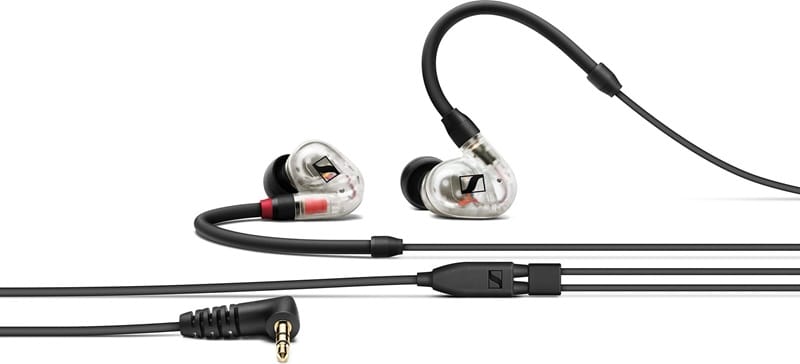
Drivers: 1 dynamic
Isolation: 26 dB
Best for: Comfort-first singers, smaller venues
The IE 100 Pro is Sennheiser's answer to the SE215. It's ultra-lightweight, extremely comfortable for long shows, and has a natural, balanced sound that many singers prefer to the warmer SE215. The trade-off is slightly lower isolation at 26 dB, so it's better suited for smaller, quieter stages.
What we love:
- One of the most comfortable IEMs on the market
- Natural, balanced sound without colored bass boost
- Replaceable cable with standard 2-pin connector
- Lightweight; you forget you're wearing them
Watch out for:
- 26 dB isolation is lower than the SE215; loud stages will bleed through more
- Slightly less bass presence than the SE215
If your priority is all-night comfort and you play smaller venues, the IE 100 Pro is worth a look over the SE215.
Check the Latest Price and Full Specs
3. Jerry Harvey Audio JH7 (Best Mid-Range for Vocalists)
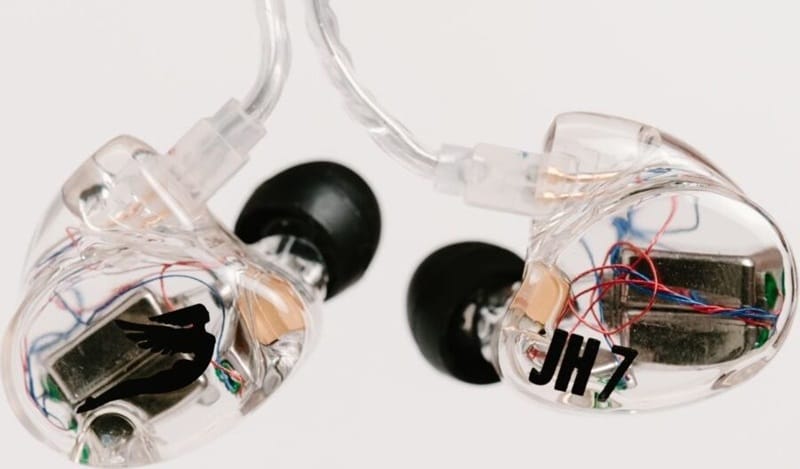
Drivers: 3 balanced armature (dual low, single mid/high)
Isolation: Up to 26 dB
Best for: Working singers who want warm, full-bodied vocal monitoring
Jerry Harvey is the man who invented the modern in-ear monitor. He built the first custom IEM for Alex Van Halen in 1995, launched Ultimate Ears, and then founded Jerry Harvey Audio in 2007 after a decade working with Aerosmith, Pearl Jam, KISS, and Linkin Park. That stage pedigree is baked into every JH Audio product, including the JH7.
The JH7 uses a triple balanced armature configuration with dual low drivers dedicated to bass and a single driver for mids and highs. That low-end depth is what makes it a standout for singers: you feel the kick drum and bass without losing clarity in the midrange where your voice lives.
What we love:
- Warm, full-bodied sound signature; unusually rich low-end for a BA IEM
- Triple BA design separates frequencies cleanly for better vocal definition
- Smooth mids and highs with no harshness; easy to listen through a long set
- Detachable 2-pin cable; straightforward to replace in the field
- Jerry Harvey's touring heritage means this is designed around real stage needs
Watch out for:
- 26 dB isolation is lower than the SE425 or SE215; better for moderate stages than very loud shows
- Warm tuning may feel slightly colored compared to neutral reference IEMs
If you want an IEM from the man who literally invented the category, and you want warmth that flatters your vocals on stage, the JH7 is a serious mid-range choice.
Check the Latest Price and Full Specs
4. Shure SE425 (Best Dual Driver Upgrade)
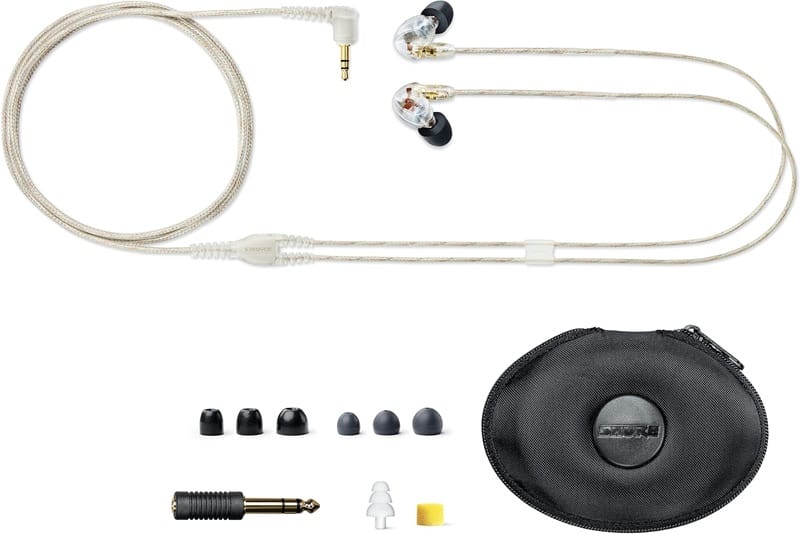
Drivers: 2 balanced armature
Isolation: 37 dB
Best for: Singers upgrading from the SE215 who want more clarity
The SE425 takes the SE215 formula and adds a second balanced armature driver. That split means one driver handles the low end and one handles the mids and highs, giving you noticeably better separation and more detail in the vocal range.
What we love:
- Dual balanced armature delivers better frequency separation than single-driver options
- Same excellent 37 dB isolation as the SE215
- Clear, detailed midrange; great for hearing pitch clearly
- Familiar Shure over-ear design with MMCX cable
- Great for singers who also want to use IEMs as studio headphones
Watch out for:
- Less bass punch than the SE215 or IE 400 Pro
- Balanced armature drivers sound slightly drier to some ears
- Pricier than the IE 400 Pro for similar driver count
If you're already a Shure fan and want the dual-driver upgrade path, the SE425 is the right next step.
Check the Latest Price and Full Specs
5. Audio-Technica ATH-E70 (Best Triple Driver for Vocal Clarity)
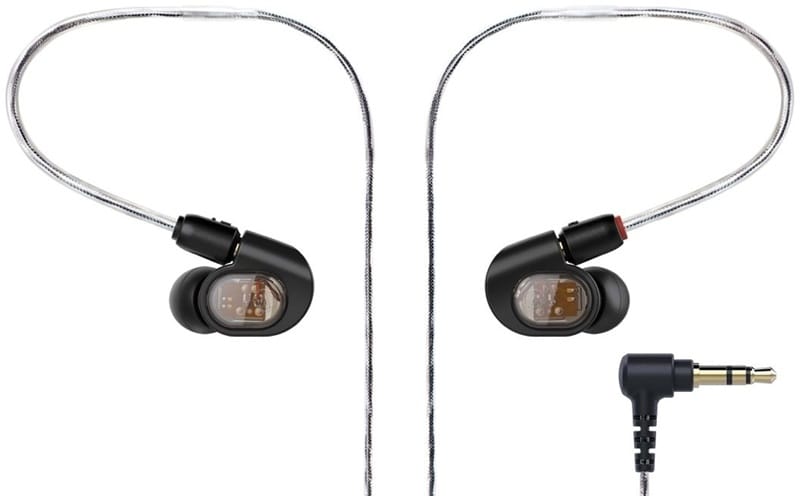
Drivers: 3 balanced armature
Isolation: 35 dB
Best for: Vocalists who prioritize mid-range precision
The ATH-E70 is Audio-Technica's flagship IEM, and it punches above its price point significantly. Three balanced armature drivers handle lows, mids, and highs separately, giving you a wide, natural soundstage that makes vocal harmonies and your own pitch easy to lock in.
What we love:
- Three separate drivers for exceptional clarity across all frequencies
- Wide soundstage; great for hearing complex musical arrangements
- Precise mid-range representation; ideal for pitch accuracy
- Comfortable for long shows with included ear hooks
- Excellent build quality at the price
Watch out for:
- Less bass impact than dynamic driver IEMs
- Slight learning curve to find the perfect seal with the ear tips
For singers who care deeply about hearing their own pitch and harmonies accurately, the ATH-E70 is one of the best values in IEMs.
Check the Latest Price and Full Specs
6. Mackie MP-460 (Best Quad Driver for Working Singers)
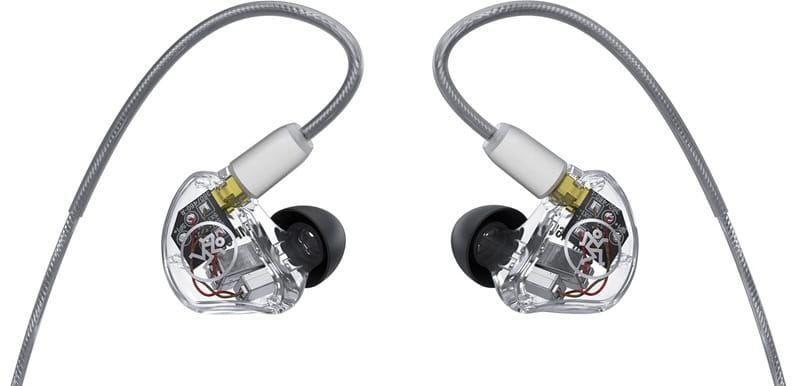
Drivers: 4 balanced armature (Knowles drivers; 2 dedicated to highs)
Isolation: Up to 40 dB
Best for: Singers who want maximum isolation and multi-driver detail
Mackie has built professional PA speakers, mixers, and stage gear for decades. The MP-460 brings that same professional build philosophy to IEMs, using quad Knowles balanced armature drivers and delivering up to 40 dB of sound isolation, which is among the best you'll find in any universal-fit IEM at any price.
Two of the four drivers are dedicated specifically to high frequencies, which means you get a smooth, detailed top end without harshness. For singers, that translates to hearing cymbals, the top of your own voice, and background vocals with real clarity.
What we love:
- 40 dB of isolation; one of the highest in any universal IEM
- Quad Knowles BA drivers; same driver brand used in high-end IEMs costing twice as much
- Two drivers dedicated to highs deliver smooth, detailed treble without sibilance
- Ergonomically molded low-profile housing; comfortable for full-length shows
- Optional Bluetooth adapter available for off-stage casual use
Watch out for:
- $499.99 price puts it in serious consideration territory
- Four BA drivers mean less bass warmth than a dynamic driver IEM
- Bluetooth adapter sold separately
If you want the best isolation in this list and four drivers of Knowles-quality audio, the MP-460 punches well above its price point.
Check the Latest Price and Full Specs
7. Shure SE846 Gen 2 (Best Overall Premium IEM)
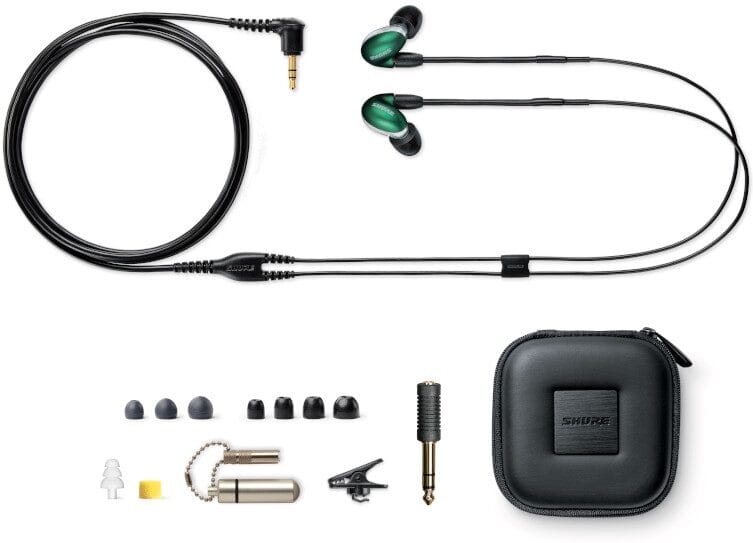
Drivers: 4 balanced armature
Isolation: 37 dB
Best for: Singers who want the best universal-fit IEM available
The SE846 Gen 2 is Shure's flagship. Four dedicated balanced armature drivers, swappable sound filters to tune the sound signature, and 37 dB of isolation in a universal-fit shell. This is the IEM you find on the ears of touring vocalists who could afford custom IEMs but choose the SE846 because it sounds that good.
What we love:
- Four balanced armature drivers; exceptional detail and separation
- Swappable filters change the sound from warm to neutral to bright
- 37 dB isolation; one of the best in any universal IEM
- Premium build with a removable cable and Shure's standard reliability
- Also excellent for studio reference listening
Watch out for:
- Expensive at $700
- Four BA drivers mean less bass punch compared to a dynamic at the same price
- Requires good ear tip fit to get the full 37 dB isolation
If budget isn't a concern and you want the best universal-fit IEM you can buy, this is it.
Check the Latest Price and Full Specs
Top 3 Wireless IEM Systems
These are the transmitter and receiver systems that send audio from the mixer to your bodypack.
1. Shure PSM300 (Best Pro Wireless IEM System)
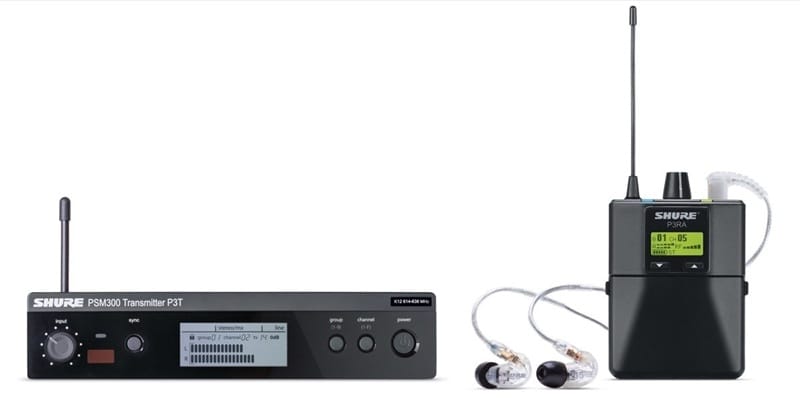
Best for: Pro singers, touring vocalists, working musicians
The PSM300 is the industry standard for wireless in-ear monitoring. Patented Audio Reference Companding technology keeps the audio transparent and artifact-free over a range of 300 feet. It has 24-bit digital audio, a rack-mountable half-rack transmitter, and a bodypack receiver with volume, EQ, and limiter control.
What we love:
- Industry-standard reliability; used on professional tours worldwide
- 300-foot wireless range with no dropouts
- 24-bit digital audio; no analog compression coloration
- One-touch frequency scan and IR sync for fast setup
- Available bundled with SE112 ($629), SE215 ($989), or buy the transmitter and use your own earphones
Watch out for:
- Expensive
- Requires licensing for specific frequency bands depending on your country
- Not for casual weekend gigging; this is pro-level gear
Check the Latest Price and Full Specs
2. Sennheiser EW IEM G4 (Best Premium Sennheiser System)
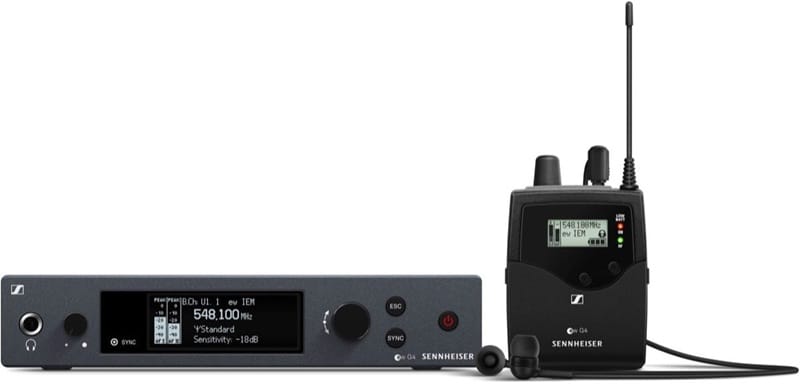
Best for: Singers who prefer Sennheiser, orchestral and theatrical performers
Sennheiser's EW IEM G4 is the main competitor to the PSM300 on professional stages. It runs on the reliable EW (Evolution Wireless) G4 platform, has a full 88 MHz frequency bandwidth, and integrates with Sennheiser's wireless control software for managing multiple systems on a complex stage.
What we love:
- Wide 88 MHz frequency bandwidth; easy to find clean channels
- Sennheiser's trusted G4 platform is road-proven and supported worldwide
- Stereo and mono operation with a versatile bodypack receiver
- Works well in environments with lots of competing wireless signals
- Pairs perfectly with Sennheiser IE earphones for a full-family system
Watch out for:
- Similar pricing to the PSM300; not a budget option
- The RF experience can be tricky in complex multi-system environments
Check the Latest Price and Full Specs
3. Sennheiser XSW IEM (Best Budget Wireless IEM System)
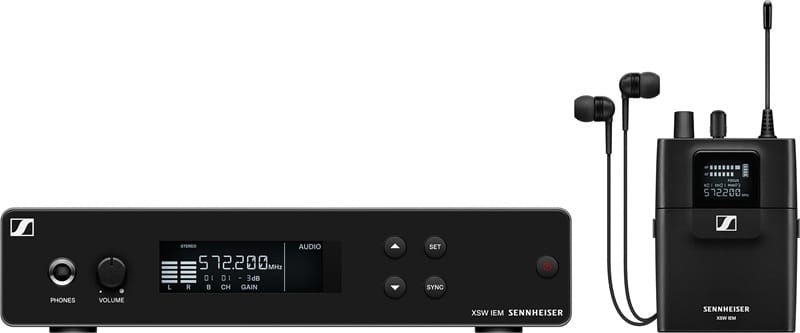
Best for: Gigging singers who want wireless IEMs without the PSM300 price
The XSW IEM is Sennheiser's more accessible wireless monitoring system. It's simpler to operate than the G4, still delivers professional-quality sound, and is perfect for singers who want the freedom of wireless IEMs without spending $1,000.
What we love:
- More affordable entry into wireless IEM monitoring
- Easy setup with automatic frequency scan
- Good RF performance for typical live music venues
- Sennheiser build quality and reliability
- Pairs well with any standard 3.5mm IEM earphones
Watch out for:
- Narrower bandwidth than the G4; more limited in RF-crowded venues
- Fewer advanced features than the PSM300 or G4
- Carries less status on professional-level touring
Check the Latest Price and Full Specs
Honorable Mentions
A few strong picks that didn't make the main list:
- Mackie MP-220: $159. Dual dynamic driver at a budget price; thick bass and clear vocals from a brand with serious stage heritage.
- Shure SE535 Pro: $445. Triple balanced armature, 37 dB isolation, and 8 sets of ear tips. A step up from the SE425 with even more driver separation.
- Audio-Technica ATH-E40: $119. Single dual-phase push-pull driver, less distortion than standard dynamics, great for budget-conscious singers.
- Jerry Harvey Audio Jessie: $129. Entry-level single dynamic driver IEM from the man who invented modern IEMs. Natural sound, lightweight, good for churches and smaller stages.
- Custom IEMs (JH Audio custom line): $500 to $3,000+. Molded from impressions of your ears; maximum isolation and fit for touring professionals.
Best In-Ear Monitors Under $100
If you are just starting with IEMs or you need a backup pair that won't hurt to lose, these two options deliver real stage-ready performance for less than $100.
Shure SE112
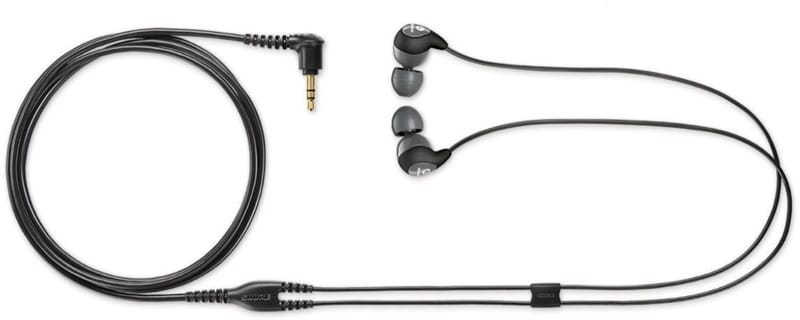
Price: $69
Drivers: 1 Dynamic MicroDriver
Isolation: 37 dB
Best for: Budget-first singers, beginners, backup pair
The SE112 is Shure's entry point into their SE monitor family, and it punches well above its price tag. It uses the same isolation sleeve technology as the higher-end SE215 and SE425, blocking up to 37 dB of ambient noise, which is a spec you normally see on IEMs that cost two or three times as much. The sound leans warm with strong bass, good for feeling the low end of the mix even on quiet stage volumes.
What we love:
- 37 dB isolation at roughly $50 is genuinely hard to beat
- MicroDriver technology borrowed from Shure's pro SE series
- Comes with three sleeve sizes (S, M, L) for a custom-feeling fit
- Deep, warm low end; connected, satisfying sound at low volumes
- Drawstring pouch included for easy storage
Watch out for:
- Fixed cable; not replaceable if it breaks
- Less detailed in the mids than the SE215 or SE425
- Best for casual monitoring and backup use, not as a primary touring IEM
For a first pair of IEMs or a spare set to keep in your gig bag, the SE112 is one of the best $50 you can spend.
Check the latest price and Full Specs
Mackie MP-120
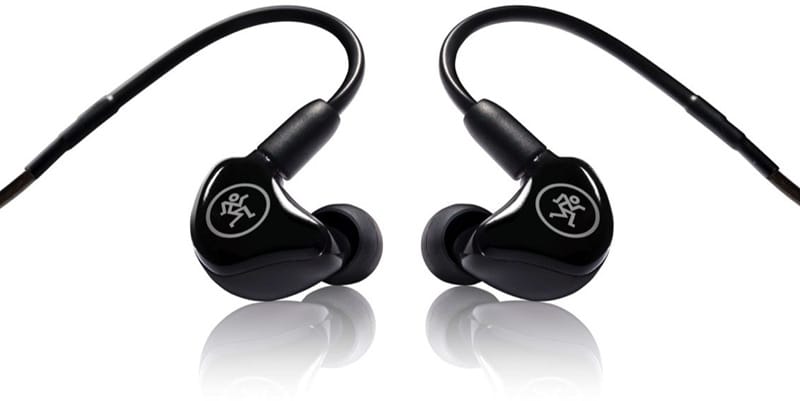
Price: $99
Drivers: 1 Dynamic (precision-tuned)
Isolation: Superior noise isolation (molded enclosure)
Best for: Singers who want accurate, neutral monitoring on a budget
The MP-120 is Mackie's entry-level IEM, and it brings two things to the table that cheaper options skip: an MMCX detachable cable and a hard case. That MMCX connection means you can swap to a third-party Bluetooth cable if you want wireless on the go, or simply replace the cable if it wears out without buying a whole new pair. The sound is neutral and accurate, more reference-like than the warmer SE112, which makes it a strong choice for singers who want to hear their mix honestly without heavy coloration.
What we love:
- MMCX detachable cable; replaceable and Bluetooth-adapter compatible
- Neutral, accurate sound signature; honest representation of your mix
- Ergonomically molded low-profile enclosure; comfortable for long sets
- Hard case included; better protection than most IEMs at this price
- Over-ear cable design keeps them locked in during active performance
Watch out for:
- Neutral sound may feel thin to singers used to bass-heavy IEMs
- Single driver; won't match dual or triple driver IEMs in separation
- Bass response is accurate rather than flattering; not the most exciting low end
If you want a step up from the SE112 with a detachable cable and more neutral sound, the MP-120 is a smart $99 pick.
Check the latest price and Full Specs
How to Set Up Your IEM System
Wired setup (simple):
1. Run a monitor send from your mixer or audio interface to a headphone amplifier (like the Behringer Powerplay P2, around $50).
2. Plug your IEM earphones into the headphone amp.
3. Set your personal mix from the monitor send.
For home practice, you can plug your IEMs directly into the headphone output of your (best-audio-interfaces-home-vocal-recording). Most 4th Gen Focusrite Scarlett interfaces have a dedicated headphone amp that powers IEMs very well. This is also a great way to practice hearing yourself in real time before you need to use IEMs on a stage.
Wireless setup (for live shows):
1. Connect the transmitter to a monitor sent from your front-of-house or monitor mixer.
2. Clip the bodypack receiver to your belt, pocket, or waistband.
3. Plug your IEM earphones into the bodypack receiver's headphone jack.
4. Sync the transmitter and receiver via IR sync.
5. Set your gain and EQ on the bodypack.
6. Rehearse with the system before showtime.
For a full overview of the home recording and practice setup side of things, check out our Singing Equipment Reviews guide.
Budget Guide: What to Buy at Every Stage
Just starting out ($100):
Get a pair of Shure SE215s and run them wired from a headphone amp or interface. Understand what you like before buying a wireless system.
Weekend gigging singer ($400):
Pair the Jerry Harvey Audio JH7 with a cheap wired bodypack amp or a direct monitor send from a digital board that has personal mixing.
Serious working singer ($700 to $1,000):
Get the Shure SE425 and the Sennheiser XSW IEM wireless system. That's around $600 to $700 total and gives you a proper wireless rig.
Pro touring singer ($1,200 to $1,700):
Pair the Shure SE846 Gen 2 with the Shure PSM300 wireless system. This is what most touring vocalists on professional shows are running.
Frequently Asked Questions
What do professional singers hear in their in-ear monitors?
A custom personal mix, usually including their own vocal (louder than anything else), a stereo mix of the full band, a click track if they use one, and sometimes a scratch vocal or guide track. Every singer's mix is different; that's the whole point.
Are in-ear monitors better than floor wedges?
For most singers, yes. IEMs give you better hearing protection, a personal mix, more consistent sound, and less feedback risk. The main downside is a feeling of disconnection from the crowd, which most singers adjust to within a few shows.
How much do professional in-ear monitors cost?
Good IEM earphones for stage use start at $100 (Shure SE215) and go to $700 plus (Shure SE846 Gen 2). Wireless IEM systems add another $550 to $900. Budget around $700 to $1,000 for a complete wireless rig.
Can I use regular earbuds as in-ear monitors?
No. Consumer earbuds don't seal the ear properly, don't handle stage volume well, and often distort in loud environments. Use earphones specifically designed for stage monitoring.
Do I need a wireless system, or can I use wired IEMs?
Many singers use wired IEMs at smaller shows just fine. Wired is simpler, cheaper, and requires no batteries. Go wireless when you need to move freely around the stage without a cable tethering you to the monitor mixer.
What's the difference between balanced armature and dynamic drivers?
Dynamic drivers move air like a miniature speaker. They're warmer with more bass impact. Balanced armature drivers are used in hearing aids and studio IEMs; they're faster, more detailed, and more accurate, but typically thinner in bass. Many singers prefer dynamic or mixed configurations for stage use.
Can I practice at home with in-ear monitors?
Absolutely. Plug your IEMs into the headphone output of your audio interface and sing along to backing tracks. It's excellent practice for learning to trust your ears instead of relying on the room. The Focusrite Scarlett 2i2 and most modern interfaces power IEMs perfectly well.
Final Picks
Best in-ear monitors for live singers at every level:
- Best Budget: Shure SE215 ($100)
- Best Budget Alternative: Sennheiser IE 100 Pro ($109)
- Best Mid-Range for Vocals: Jerry Harvey Audio JH7 (599)
- Best Dual Driver: Shure SE425 ($267)
- Best for Vocal Clarity: Audio-Technica ATH-E70 ($439)
- Best Quad Driver: Mackie MP-460 ($529)
- Best Overall: Shure SE846 Gen 2 ($890)
- Best Wireless System: Shure PSM300 ($989)
- Best Budget Wireless: Sennheiser XSW IEM ($649)
For a complete picture of all the gear a singer needs for live and studio performance, visit our Singing Equipment Reviews guide. And for help choosing the right audio interface to practice with at home, see our Best Audio Interfaces for Home Vocal Recording review.