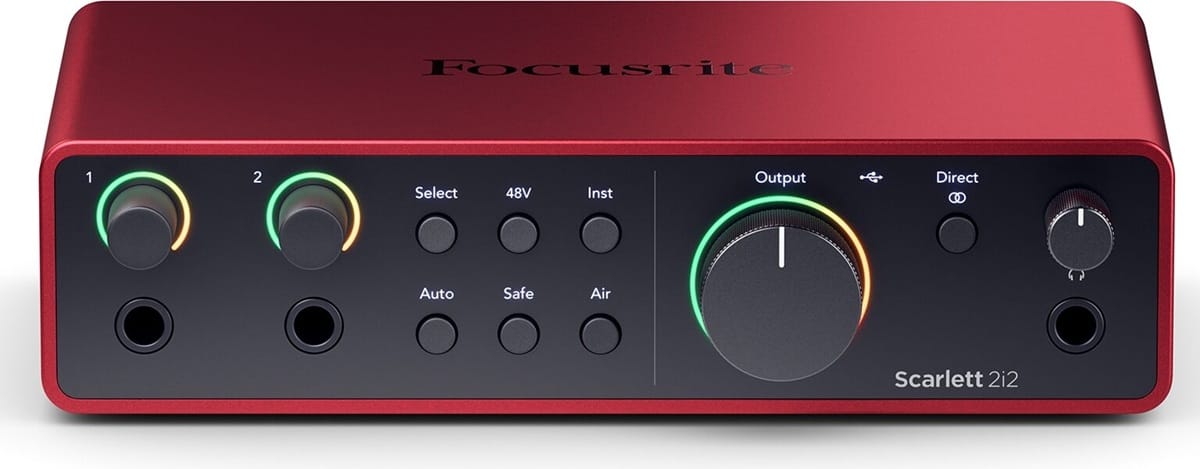
The best audio interfaces for home vocal recording in 2026 are the Focusrite Scarlett 2i2 (4th Gen) for most singers, the Universal Audio Volt 2 if you want warm tube-style vocal tone, and the SSL 2+ MkII if you want pro console color on a singer-friendly budget.
An audio interface is the box that turns your XLR microphone signal into clean digital audio that your computer can record. Pick the wrong one, and you'll be fighting noise and weak gain forever. Pick the right one and your vocal tracks will sound like they came out of a real studio.
This guide breaks down the top 8 audio interfaces worth buying for singers right now. Every pick was chosen based on preamp quality, real-world ease of use, current 2026 prices, and how well it pairs with the kind of microphones singers actually use. We'll cover what to look for, the best models at every budget, and how to set yours up so your recordings sound their best.
What an Audio Interface Does (And Why Singers Need One)
An audio interface is the bridge between your microphone and your computer. Your XLR mic produces an analog signal, but your computer can only record digital audio. The interface takes that analog signal, runs it through a preamp to boost the level, then converts it to digital and sends it into your DAW.
Why does this matter for singers? A few reasons:
- Better sound quality. The mic preamp inside your interface controls how clean and clear your vocal sounds.
- More gain. Some mics (looking at you, Shure SM7B) need a lot of clean gain. Cheap interfaces struggle. Quality interfaces don't.
- Phantom power for condensers. Most condenser mics need 48V phantom power, which an interface provides.
- Direct monitoring. You can hear yourself in real time without delay.
- Lower noise. Quality converters mean less hiss and more headroom.
Yes, USB microphones skip the interface entirely. But once you want a real condenser or dynamic mic with XLR, you need an interface. There's no way around it.
What to Look For in a Vocal Audio Interface
Focus on these 6 features when shopping:
1. Preamp quality and clean gain. For most condensers, 50 dB of gain is plenty. For the Shure SM7B, you want 60 dB or more.
2. Number of inputs. Singers need 1 to 2. Solo artists are fine with 1; if you want to record vocals and guitar at the same time, get 2.
3. Connection type. USB-C is the modern standard. Avoid old USB-A only models in 2026.
4. Direct monitoring with zero latency. Critical so you can hear yourself in real time.
5. Sample rate and bit depth. 24-bit at 48 or 96 kHz is plenty for vocals.
6. Bundled software. Many interfaces come with free DAW licenses, plugins, and presets. That can save you hundreds.
You don't need 8 inputs. You don't need Thunderbolt. You don't need DSP. Most singers thrive with a 2-input, USB-C interface and a quality preamp.
Quick Comparison Table
| Interface | Best For | Price | Gain (dB) | Inputs |
|---|---|---|---|---|
| Focusrite Scarlett 2i2 (4th Gen) | Best overall | $225 | 69 dB | 2 |
| Universal Audio Volt 2 | Warm vocal tone | $200 | 55 dB | 2 |
| SSL 2+ MkII | Pro console color | $300 | 62 dB | 2 |
| Audient iD4 MK2 | Premium preamps | $300 | 58 dB | 1 |
| Focusrite Scarlett Solo (4th Gen) | Simple solo setup | $160 | 69 dB | 1 |
| PreSonus AudioBox GO | Cheapest decent | $128 | 50 dB | 2 |
| Universal Audio Volt 176 | Single mic + compressor | $200 | 55 dB | 1 |
| Universal Audio Apollo Solo | Premium pick | $700 | 65 dB | 1 |
You can grab any of these through Zzounds with free shipping and a payment plan that splits bigger purchases into 4 or 12 interest-free payments.
Top 8 Audio Interfaces for Vocal Recording
1. Focusrite Scarlett 2i2 (4th Gen) (Best Overall)
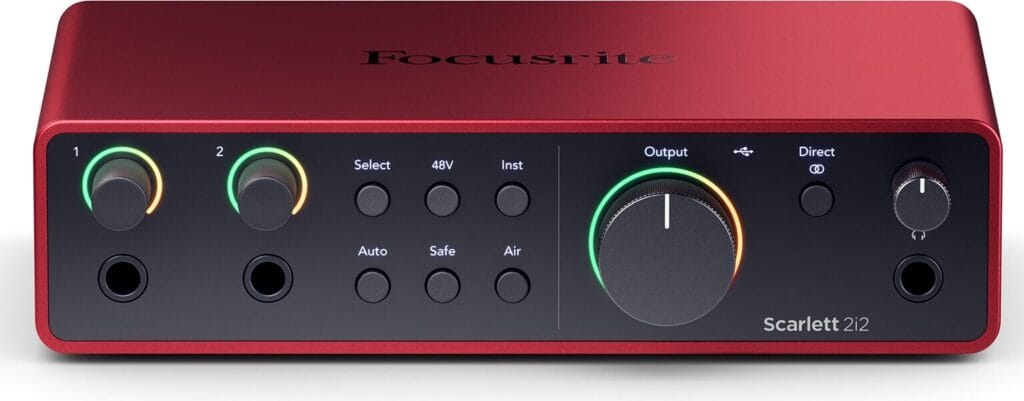
Best for: Most singers, beginners through intermediate
Inputs: 2 (mic / line / instrument)
Gain: 69 dB
The Scarlett 2i2 is the most popular audio interface ever made, and the 4th Gen is the best version yet. Improved preamps, more gain than past versions (now 69 dB, which can power even an SM7B without a Cloudlifter), and clean low-latency performance.
What we love:
- 69 dB of clean gain; handles the gain-hungry SM7B
- "Air" button adds a presence boost that flatters vocals
- Built like a tank in that famous red aluminum body
- Comes bundled with free DAW (Ableton Live Lite or Pro Tools Intro), plugins, and a 3-month subscription to Splice
- 3-year warranty (longer than most competitors)
- Auto-gain feature is great for beginners
Watch out for:
- Preamps are clean but not "characterful"; some singers prefer warmer-sounding options
- USB-C cable included but not always long enough; budget for an extra
If you have no idea what to buy and you just want the safe pick that works, this is the one. You won't regret it.
Check the Latest Price and Full Specs!
2. Universal Audio Volt 2 (Best for Warm Vocal Tone)
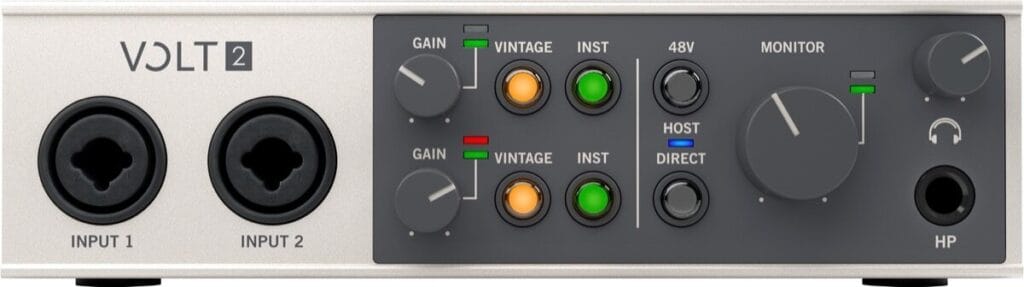
Best for: Singers who want analog warmth
Inputs: 2
Gain: 55 dB
The Volt 2 is Universal Audio's answer to the Scarlett, and it brings something the Focusrite doesn't: a built-in Vintage mode that emulates the legendary UA 610 tube preamp. Press the button and your vocals get that warm, rich, analog sound that singers chase with plugins.
What we love:
- Vintage tube preamp mode adds warmth that flatters most voices
- Solid USB-C build with a clean, modern look
- Comes with UAD's free plugin bundle including LUNA recording software
- Great for singer-songwriters who want a touch of vibe baked into every recording
- Reliable drivers on Mac and Windows
Watch out for:
- 55 dB of gain may not be enough for the SM7B without a Cloudlifter
- 1-year warranty (Focusrite gives 3)
- Less gain than the Scarlett 2i2
If you mainly use condenser mics and want vocal recordings that already have analog character before you even open a plugin, this is the one to grab.
Check the latest price and full specs!
3. SSL 2+ MkII (Best Pro Console Color)
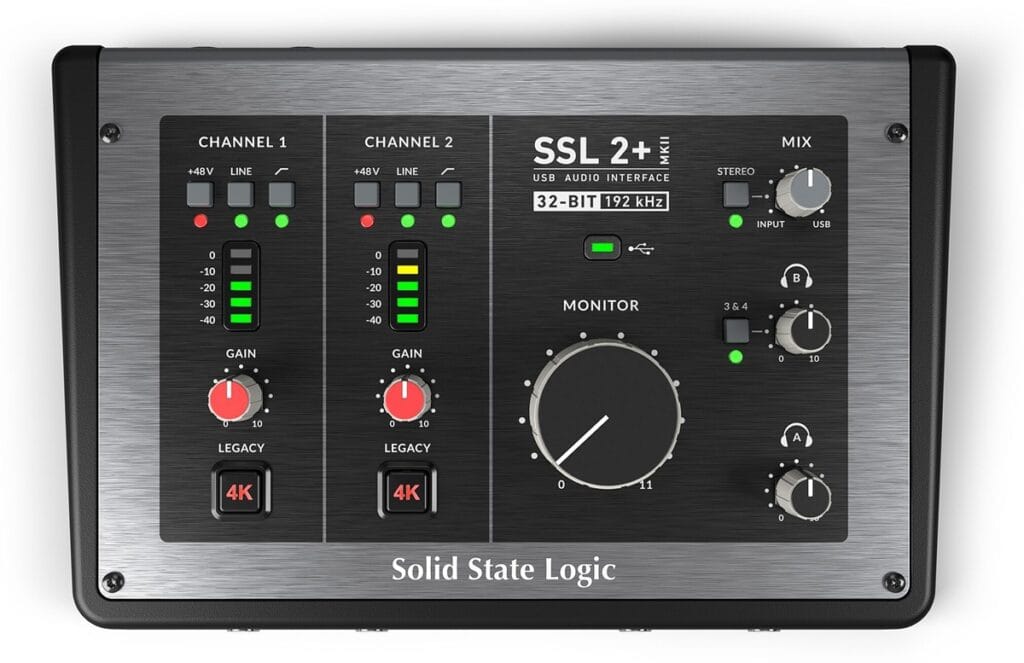
Best for: Singers who want SSL console sound
Inputs: 2
Gain: 62 dB
Solid State Logic is the legendary British console brand behind countless number-one records. The SSL 2+ MkII brings that heritage into a home studio interface, and the "Legacy 4K" button adds the high-frequency sheen of the SSL 4000 series console to your vocal recordings with one press.
What we love:
- Legacy 4K Enhancement adds pro console character to vocals
- 62 dB of clean gain handles most mics including the SM7B
- Four headphone outputs (great if you record with a duet partner or coach)
- Console-grade preamps; some of the best in this price range
- Bundled software includes Ableton Live Lite and SSL plugins
Watch out for:
- Pricier than the Scarlett or Volt
- Larger footprint takes up more desk space
- 4K mode can be too bright on already-bright voices; use it as a choice, not a default
For singers who want to stand out from the millions of Scarlett users, the SSL 2+ MkII gives your tracks a more polished, professional sound out of the gate.
Check the latest price and full specs!
4. Audient iD4 MK2 (Best Preamp Quality at Budget Price)
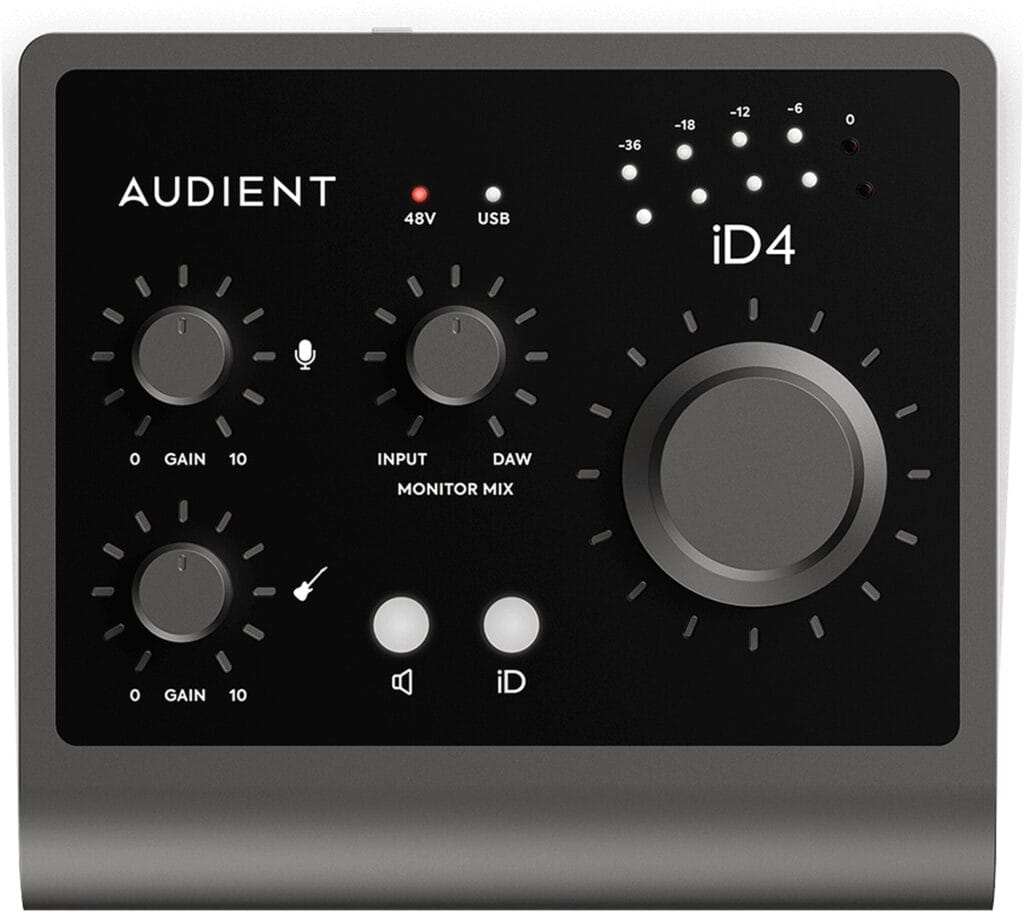
Best for: Singers who care about pristine clean sound
Inputs: 1 mic + 1 instrument
Gain: 58 dB
Audient is the engineer's engineer brand. The iD4 MkII has console-grade Audient preamps borrowed from their pro-tier hardware, packaged into a tiny budget-friendly box. If you want the cleanest, most transparent capture of your voice without color or coloration, this is the interface.
What we love:
- Some of the cleanest preamps in this price range
- Excellent JFET instrument input (great if you also play guitar)
- ScrollControl turns the volume knob into a mouse scroll wheel; small but useful
- Sturdy metal build
- 3-year warranty
Watch out for:
- Only 1 mic input; not for tracking two singers at once
- No "color" or vintage modes; this is a clean preamp, not a flavored one
- 58 dB may need a boost for the SM7B
If your priority is the most honest, transparent vocal recording you can get at $200, the iD4 MkII is hard to beat.
Check the latest price and full specs!
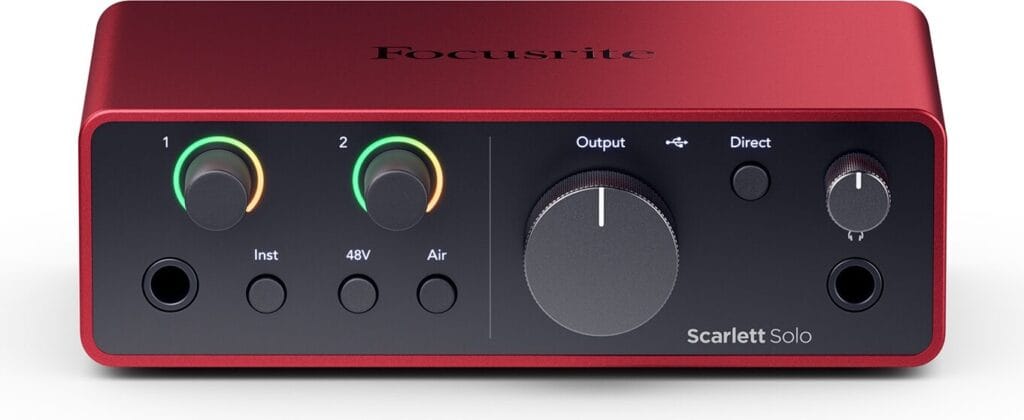
5. Focusrite Scarlett Solo (4th Gen) (Best Simple Solo Setup)
Best for: Solo singers, beginners on tight budgets
Inputs: 1 mic + 1 instrument
Gain: 69 dB
If you only ever record one thing at a time (which is most singers), you don't need 2 inputs. The Scarlett Solo gives you the same preamps and "Air" mode as the 2i2 in a smaller, cheaper package.
What we love:
- 69 dB of clean gain; powers the SM7B without help
- "Air" mode for that presence boost on vocals
- Compact, fits on any desk
- Same Focusrite reliability and bundled software
- $70 cheaper than the 2i2
Watch out for:
- Only one mic input; you can't record vocals and a duet partner simultaneously
- No second headphone output
If you record yourself, by yourself, and you don't need extras, the Scarlett Solo is the smartest budget pick in this lineup.
Check the latest price and full specs!
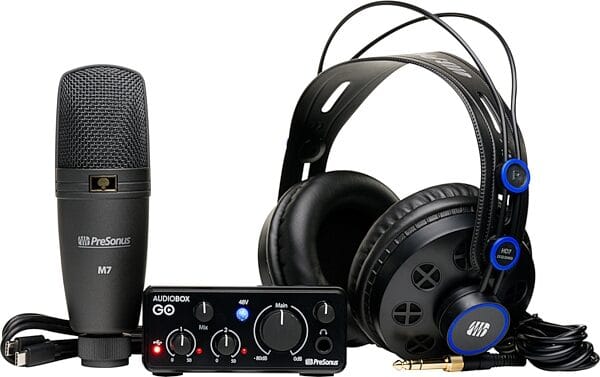
6. PreSonus AudioBox GO (Best Cheapest Decent Option)
Best for: Beginners on the tightest budget
Inputs: 1 mic + 1 instrument
Gain: 50 dB
If you need a real audio interface for less than $100, the AudioBox GO is the one. It's small, USB-powered, and gives you decent preamps with phantom power. Now part of the Fender family, the build and support are solid.
What we love:
- Cheapest decent interface on the market in 2026
- Bus-powered through USB-C; no extra adapters needed
- Comes with PreSonus Studio One Prime DAW for free
- Works on Mac, Windows, iPad
- Tiny footprint; great for travel or tight desks
Watch out for:
- Only 50 dB of gain; won't power the SM7B properly
- Plastic build feels less premium
- Driver support is solid but not as bulletproof as Focusrite
If you're stretching every dollar and just want to start recording, this is your starter interface. You can always upgrade later.
Check the latest price and full specs!
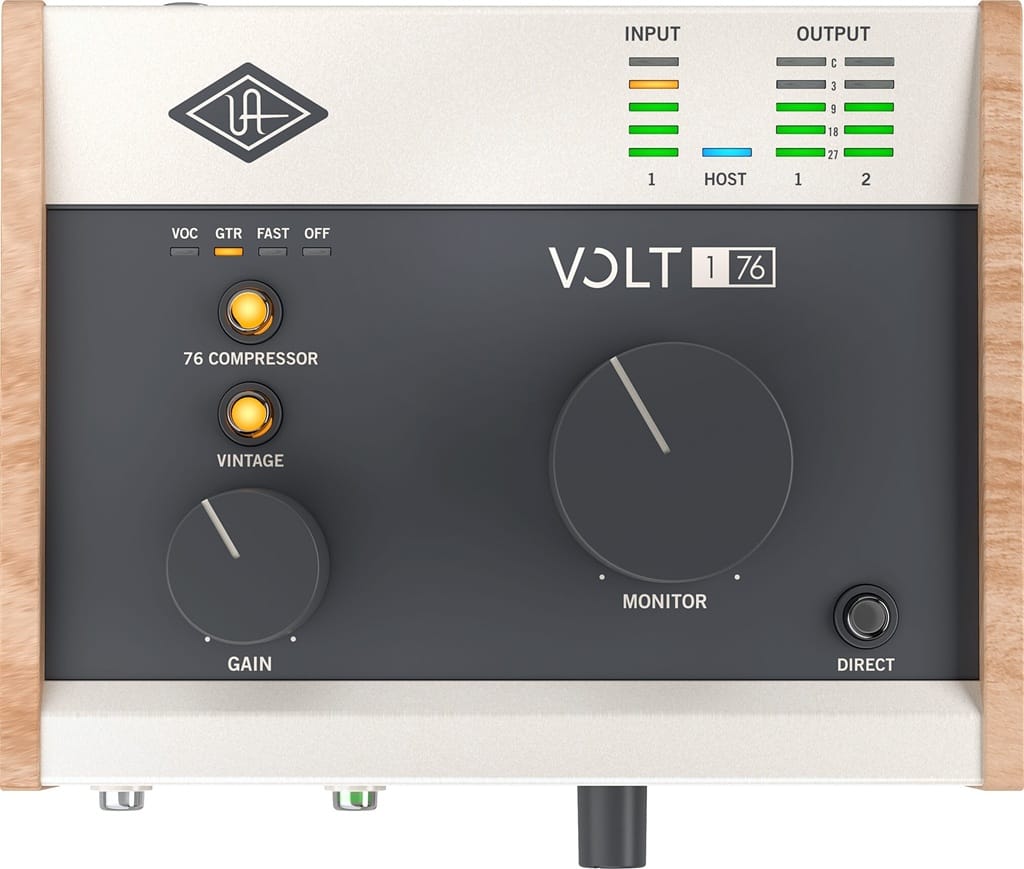
7. Universal Audio Volt 176 (Best Single-Input with Built-In Compression)
Best for: Solo singers who want analog compression on the way in
Inputs: 1 mic + 1 instrument
Gain: 55 dB
The Volt 176 is the Volt 2's sibling, but with a secret weapon: a built-in 1176-style compressor circuit. Press the button and your vocal gets the punch, glue, and presence of the most famous studio compressor in history, applied directly to the signal as you record.
What we love:
- Built-in 1176-style compressor adds character on the way in
- Same Vintage tube preamp mode as the Volt 2
- One of the best-sounding single-input interfaces on the market
- Bundled UAD plugins
- Compact, beautiful design
Watch out for:
- Only 1 mic input
- 55 dB of gain may need a boost for the SM7B
- "Baked in" compression is a creative choice; you can't undo it after recording
If you only need to record vocals one at a time and you love the idea of analog character built into every track, the Volt 176 is a special interface.
Check the latest price and full specs!
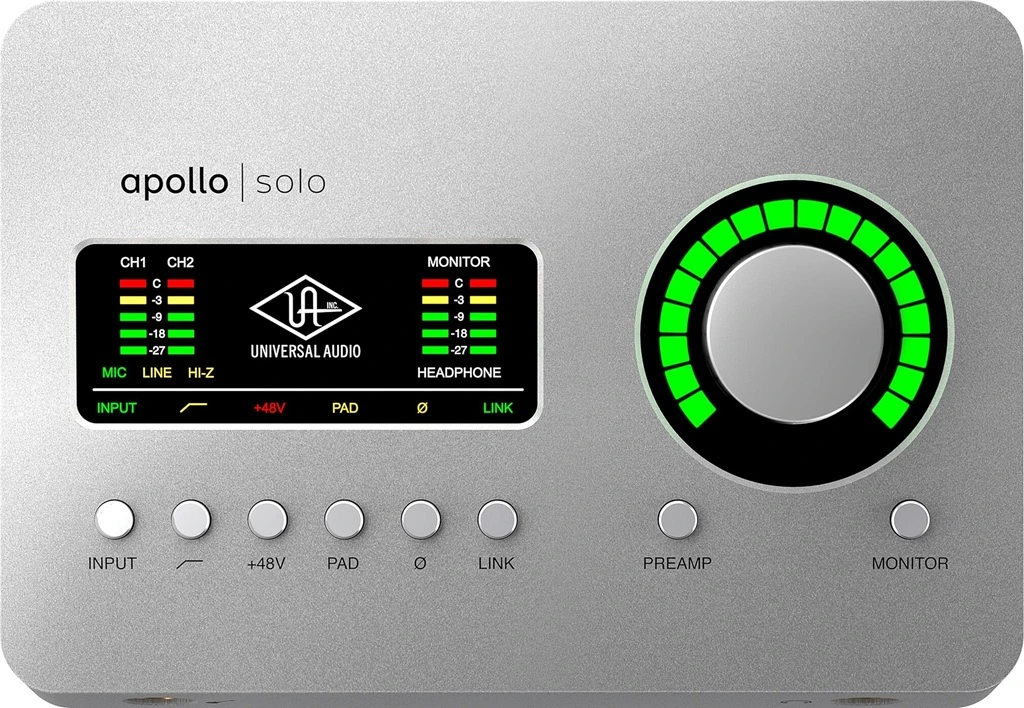
8. Universal Audio Apollo Solo (Best Premium Pick)
Best for: Serious singers who want pro studio sound from home
Inputs: 2
Gain: 65 dB
The Apollo Solo is where home studio meets pro studio. You get Universal Audio's pristine Unison preamps, onboard DSP that lets you track through legendary UAD plugins (Neve, API, SSL, 1176, LA-2A) with zero latency, and Thunderbolt 3 connectivity for the lowest latency in this lineup.
What we love:
- Pro-tier Unison preamps that emulate classic console preamps
- Onboard DSP runs UAD plugins in real time, no CPU hit
- Tracking through a virtual Neve 1073 or LA-2A is a game changer
- Thunderbolt 3 for incredibly low latency
- Built like a fortress; will last decades
Watch out for:
- Thunderbolt 3 not as universally compatible as USB
- Requires the UAD Console software to use DSP fully
- Some Apollo models are Mac-only; verify before buying
If you're serious about a long-term home studio and you want one piece of gear that puts you in pro territory, this is it.
Check the latest price and full specs!
Honorable Mentions
A few more interfaces that didn't make the top 8 but deserve consideration:
- MOTU M2 ($200): One of the cleanest sounding interfaces in the budget tier. Beautiful color screen meters.
- Audient iD14 MK2 ($400): Step up from the iD4 with more I/O and even better preamps.
- Antelope Audio Zen Quadro ($730): Synergy Core Processing
- Universal Audio Apollo Twin X ($1,200): Pro home studio+ Edition. Premium DSP and converters.
- Fender Quantum LT 4 ($170): Solid mid-budget option, simple and reliable.
- IRig Pro Duo ($230): Made for traveling musicians, very portable and rugged.
All available with interest-free payment plans on bigger purchases.
How to Pick the Right Interface for Your Microphone
The right interface depends mostly on what mic you use:
- Shure SM7B or other low-output dynamics? You need 60 dB or more of clean gain. Pick the Focusrite Scarlett 2i2, Focusrite Scarlett Solo, SSL 2+ MkII, or Apollo Solo. Lower-gain interfaces will work too, but you'll want a Cloudlifter ($150).
- Condenser microphone (AT2020, Rode NT1, Neumann TLM 102)? Almost any interface works. 50 to 60 dB of gain is plenty.
- Shure SM58 or other handheld dynamics? Most interfaces handle these fine.
- USB mic? No interface needed.
If you want one rule of thumb, default to the Scarlett 2i2 (4th Gen) unless you have a specific reason to pick something else. It's the safest pick for most singers.
For more on choosing a mic to pair with your interface, see our guide on Singing Equipment Reviews and our Best Microphones for Singers review.
Setup Tips for Cleaner Vocal Recordings
Once you have your interface, here's how to actually get the best sound out of it:
1. Set gain so your loudest moments peak around -12 dB to -6 dB. Never push into the red.
2. Use a quality XLR cable. Mogami and Canare cables are reliable. Bad cables cause hum and dropouts.
3. Engage phantom power (48V) for condensers; never for ribbon mics. Dynamics don't need it but won't be hurt by it.
4. Use direct monitoring while tracking. Software monitoring through the DAW introduces latency.
5. Buffer size matters. Set your DAW's buffer to 128 samples or lower when tracking; raise it to 512 or higher when mixing.
6. Keep your interface off the desk surface for vibration isolation. A small foam pad or isolator works.
7. Update your drivers. Most issues come from outdated firmware or drivers.
A clean signal chain into your interface gives you clean recordings. Bad input equals bad output, no matter how nice the gear is.
Frequently Asked Questions
What is the best audio interface for vocal recording?
For most singers, the Focusrite Scarlett 2i2 (4th Gen) is the best balance of preamp quality, features, gain, and price. It powers nearly any microphone, has clean preamps with a useful "Air" mode for vocals, and comes with bundled software.
Do I need an audio interface for vocal recording?
If you use an XLR microphone, yes. If you use a USB microphone, no. XLR mics provide better sound quality and more flexibility but require an interface to connect to your computer.
How much gain do I need for a Shure SM7B?
The SM7B needs about 60 dB of clean gain. The Focusrite Scarlett 2i2 (4th Gen) at 69 dB, the SSL 2+ MkII at 62 dB, and the Universal Audio Apollo Solo at 65 dB all handle the SM7B without help. For lower-gain interfaces, add a Cloudlifter ($150).
Is the Focusrite Scarlett 2i2 worth it in 2026?
Yes. The 4th Gen now has 69 dB of gain (up from 56 dB in older versions), much better preamps, and the same reliable drivers. It remains the most popular interface in home studios for good reason.
What's the difference between the Scarlett Solo and the 2i2?
The Solo has 1 mic input; the 2i2 has 2 mic inputs. Both have the same preamps and "Air" mode. If you only ever record one thing at a time, save the money and get the Solo.
Can I record professional vocals with a $200 interface?
Yes. Tons of hit records are tracked through interfaces in this price range. The mic and the room matter more than the cost of the interface.
USB or Thunderbolt for vocal recording?
USB is fine for vocal recording. Thunderbolt is faster and lower latency but mostly matters for tracking many channels at once or running heavy DSP. Don't overpay for Thunderbolt unless you need it.
Where should I buy an audio interface?
Zzounds is a singer-friendly retailer with free shipping and a payment plan that splits bigger purchases into 4 or 12 interest-free payments. Great for stretching the budget without sacrificing quality.
Final Picks
Best audio interfaces for home vocal recording, ranked by use case:
- Best Overall: Focusrite Scarlett 2i2 (4th Gen)
- Best for Warm Vocal Tone: Universal Audio Volt 2
- Best Pro Console Sound: SSL 2+ MkII
- Best Cleanest Preamps Under $200: Audient iD4 MkII
- Best Single-Input Solo Pick: Focusrite Scarlett Solo (4th Gen)
- Best Under $150: PreSonus AudioBox GO
- Best with Built-In Compression: Universal Audio Volt 176
- Best Premium: Universal Audio Apollo Solo
The interface is one of those purchases you only make every 5 to 10 years. Buy quality once and you'll never have to think about it again. Pair the right interface with a great vocal microphone and proper vocal techniques from programs like Roger Love, Singorama, or The Vocalist Studio by Robert Lunte, and you'll get studio-grade recordings from your bedroom.