
30 Day Singer vs Singorama
So, you want to learn to sing at home? Can a few minutes a day with online singing lessons really change your voice? You’ve probably seen both programs, and now you are trying to figure out which one is worth your time and money.
I get it, private voice lessons run $50 an hour and up. Dropping that kind of cash every week is not realistic for most people. That’s what makes online singing courses so appealing—you get structured training for a fraction of the price.
But 30 Day Singer and Singorama are very different animals. One’s a subscription with video lessons, a daily plan, and new stuff added all the time. The other is a one-time buy with downloadable MP3 lessons you keep forever. Same goal, totally different experience.
Let me be upfront: neither of these will make you sound like Adele next month. That is not how singing works. What they can do though, if you stick with practicing regularly, is build real habits that make a noticeable difference over time.
Here is how the two stack up across everything that matters.
30 Day Singer vs Singorama
Side-by-side breakdown of what you actually get
| Feature | 30 Day Singer Subscription | Singorama One-Time Buy |
|---|---|---|
| Format | HD video lessons | Downloadable MP3 audio lessons |
| Pricing | $29.95/mo or $129/year | $67–$97 one time Best Value |
| Access | Subscription — lose access on cancel | Lifetime ownership Keep Forever |
| Structure | Guided daily plan with two 30-lesson beginner tracks Structured | Self-paced, 28 audio lessons |
| Lesson Length | 10–15 min/day | ~20 min (30–45 with practice) |
| Community | Forum, live masterclasses, coaching add-on ($45–$150) | None — fully self-guided |
| Updates | Regularly updated, growing library Fresh Content | Static — no new content added |
| Extras | Downloadable exercises, genre & style courses | eBooks, metronome, recording software, Jayde Musica, meditation guide |
| Best For | Beginners who want daily guidance and visual demos | Budget-conscious learners who prefer offline practice |


Which One Fits the Way You Actually Practice?
Forget which program is “better.” That’s the wrong question. The right question is: which one is best for me?
Think about what usually makes you quit something. If you tend to fall off when you don’t have a clear next step, 30 Day Singer’s daily plan removes that friction. It tells you exactly what to do. If you hate monthly charges or get annoyed when you can’t practice without Wi-Fi, Singorama’s one-and-done purchase model and offline MP3s solve that problem instead.
There is a learning style piece too. Some people need to watch someone demonstrate mouth shape, posture, how to breathe from the diaphragm. Video makes that click. Other people learn better by ear—they want to hear a pitch, match it, repeat it fifty times. Audio works fine for that. Neither approach is wrong. But picking the wrong format for your brain means you will probably stop using it within a month.
What You Actually Get Inside 30 Day Singer
Think of 30 Day Singer as having a coach who shows up every day with a short assignment. You open the platform, follow the lesson, and you’re done in about 10 to 15 minutes. The Lesson History feature remembers where you left off, which is a small thing but makes a big difference when life gets busy.
The Beginner Curriculum
There are two 30-lesson beginner tracks. Level 1 starts with the boring, but necessary stuff: posture, breathing mechanics, vocal anatomy. You will also work on pitch control, ear training, and stretching your range. It feels basic at first. That’s by design, these are the building blocks that everything else depends on.
Level 2 ramps up. You get into belting, falsetto, mixing registers, scales, chords, and harmonizing. By the end of it, you’re doing things like creating your own harmony parts and running through cool-down routines. It’s a noticeable jump from where you started.
One nice touch: you pick a male or female instructor for the main modules. Sounds minor, but it’s way easier to mimic technique when the demo voice is in a similar range to yours.
Warm-Ups and Vocal Health
The warm-up section is honestly one of the better parts. They’ve organized everything into categories—daily routines, performance prep warm-ups, register workouts for smoothing out chest-to-head transitions, and cool-downs after intense sessions. There’s even a vocal health toolkit that covers stuff like recovering from strain and avoiding bad habits that damage your voice over time.
A lot of these exercises are downloadable too. So you can throw them on your phone and run through warm-ups in the car or before a rehearsal without needing the full platform open.
Beyond the Basics
Once you’re past the beginner tracks, there’s a pretty deep catalog. Advanced modules on runs and embellishments, vibrato, breath control, belting, mix voice, and performing with confidence. They also have courses on singing while playing guitar, piano, or ukulele, which is a niche thing, but useful if that’s your situation.
The Signature Style lessons are fun. They break down phrasing habits of specific artists like Rihanna, Ariana Grande, Adele, Ella Fitzgerald. There are genre tracks too: pop, country, R&B, classical, jazz, acapella, and even Christmas songs.
Fair warning though, the genre coverage is wide but not super deep. If you want serious R&B or gospel coaching, you might eventually need something more specialized like HearAndPlay Vocal Mastery.
Community and Live Sessions
There’s a community forum, though honestly the activity level varies. The bigger value is the masterclass archive. Users mention having access to well over a hundred recorded sessions on topics like ear training, singing with emotion, and stage presence. New ones get added regularly, so the library is always growing.
If you want actual one-on-one feedback, coaching sessions are available as an add-on. They run between $45 and $150 depending on who you book and how long the session is. Not cheap, but still less than most in-person voice teachers charge.
What You Actually Get Inside Singorama
Singorama is different. You pay once, download everything, and you are on your own. No hand-holding, no daily plan, no coach checking in. For some people, that’s a dealbreaker, for others, it’s exactly what they want.
The Lessons
You get 28 audio lessons, each running about 20 minutes of actual instruction. In practice though, most sessions stretch to 30 or 45 minutes because you will be pausing to repeat exercises. The early lessons cover fundamentals—lip rolls, sirens, basic warm-ups. Around lesson 8 to 11, things shift into range extension and interval training.
On top of the lessons, you get 20 vocal exercises built for repetition, three original songs to practice with, four eBooks, a metronome, basic recording software so you can listen back to yourself, access to Jayde Musica for music notation, and a 20-minute guided meditation aimed at performance anxiety. It’s a lot of extras for a sub-$100 package.
Where It Falls Short
No video. That’s the big one. You won’t see how an instructor positions their jaw, shapes vowels, or demonstrates breathing mechanics. If you’re someone who needs to see it to get it, that’s a real limitation.
There’s also no community, no live feedback, and no content updates. The platform looks dated compared to what’s out there now. And 9 of the 28 lessons cover broader musician topics rather than pure vocal technique, which dilutes the focus a bit.
That said—the offline angle is genuinely useful. You can run lessons like a playlist. No Wi-Fi needed, no screen to stare at. For someone who practices during a commute or wants to loop drills while doing other things, that matters more than a slick interface.
Let’s Talk Money
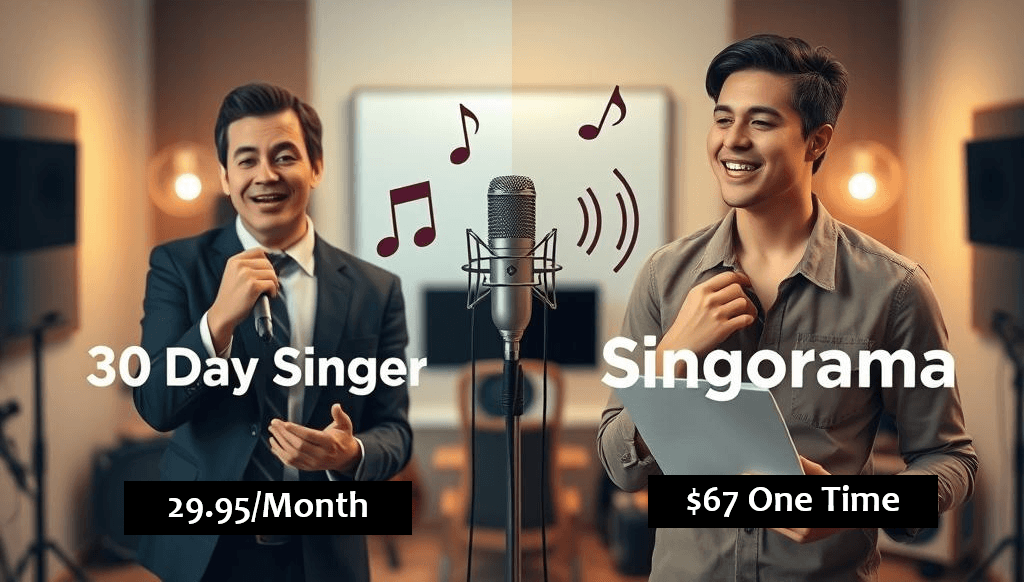
30 Day Singer lets you start with a free account to test things out. After that, it’s $29.95 a month or $129 for a full year (which breaks down to roughly $10.75/month). Some promos include a short free trial.
Singorama is a flat $67 to $97 one time, depending on which package you go with.
Quick math: paying $29.95/month for 30 Day Singer, you will spend more than Singorama’s price within three to four months. The annual plan at $129 costs more upfront than Singorama on day one, but you get a constantly growing library and masterclass access baked in.
Bottom line—if you plan to use a singing course for six months or more, Singorama saves you real money. If you just want two or three months of guided training to build a foundation, 30 Day Singer’s monthly plan gives you flexibility to cancel once you have gotten what you need.
What Using Each Platform Actually Feels Like

30 Day Singer looks and feels modern. Clean layout, left-side navigation, progress tracking. You always know where you are and what’s next. People consistently say the interface is easy to use, and I think that matters more than it sounds—if finding your next lesson feels like a chore, you’re going to skip days.
Singorama is more bare-bones. The interface gets described as “dated” a lot, and that’s fair. But the content is organized clearly enough, and once you’ve downloaded everything, you’re really just working from audio files anyway. The wrapper doesn’t matter much at that point.
Here’s something worth thinking about: video lessons tend to be more engaging for short daily sessions because you’re watching and copying in real time. Audio is better for longer practice where you don’t want screen distractions.
Where and when do you usually practice? That should guide your choice more than any feature comparison.
How They Handle Pitch, Tone, and Range

Both programs go after the same three things every singer wants to improve.
30 Day Singer tackles these through dedicated video lessons. There are specific modules on pitch and intonation, tone quality, range extension, and vowel modification.
The advantage here is that you can watch the instructor demonstrate what “right” looks and sounds like. When you are not sure what you’re doing wrong, the ability to see the physical technique makes it easier to correct.
Singorama approaches the same skills differently—through audio drills. Interval patterns, range exercises, repetitive sets designed to train your ear and build muscle memory over time. Less flashy, but effective if you’re the type who learns by doing something a hundred times until it clicks.
So, Who Should Go With 30 Day Singer?

Pick this one if you are starting from zero and want someone to hold your hand through the process. The structured daily plan takes away the guesswork. You just show up, do the lesson, and move on. It’s also the better pick if you learn visually, want access to live masterclasses, or think you might eventually want one-on-one coaching down the road.
The downsides are real though. Cancel your subscription and you lose everything. The early lessons can feel painfully basic if you already have some experience. And costs stack up—especially if you add coaching on top of the subscription.
And Who Should Go with Singorama?

This makes sense if you hate subscriptions, plain and simple. Pay once, own it forever. It’s perfect for people on a tight budget who are disciplined enough to practice without needing accountability.
The offline friendly format is great when you don’t have Wi-Fi, or prefer longer uninterrupted practice sessions. And the bundled extras - eBooks, metronome, recording software, and notation training, add more value than you’d expect for the price.
But you’re giving up a lot. No video demonstrations. No community. No live feedback. No updates. You need to be honest with yourself about whether you will actually stick with a self-guided audio course, because there is nobody nudging you when you fall off.
A Quick Gut-Check Before You Buy
Run through these four questions and you will know which one to pick:
How do you feel about monthly charges? If recurring payments stress you out, Singorama’s one-time fee eliminates that entirely. If you don’t mind subscriptions, 30 Day Singer gives you more flexibility.
Do you need to see it to learn it? If watching demonstrations is how things click for you, go with video. If you’re more of a “play it back and repeat” learner, audio works.
How much structure do you need? Be honest. If you have ever bought a course and never finished it, the daily plan in 30 Day Singer might be what keeps you going. If you’re naturally self-motivated, Singorama’s open format won’t be a problem.
Are you in this for months or years? Singorama’s fixed library doesn’t grow. 30 Day Singer keeps adding lessons and masterclasses.
At the end of the day, the right program is whichever one fits your lifestyle best. Consistency beats everything else when it comes to singing.

Note: This post contains affiliate links to recommended products. As an affiliate partner, I earn a percentage commission on qualifying purchases made through these links; however, the price for you as a buyer remains unchanged, so you don't lose out. These commissions enable me to continue creating and maintaining independent, tried-and-tested, customer-focused product recommendations."